

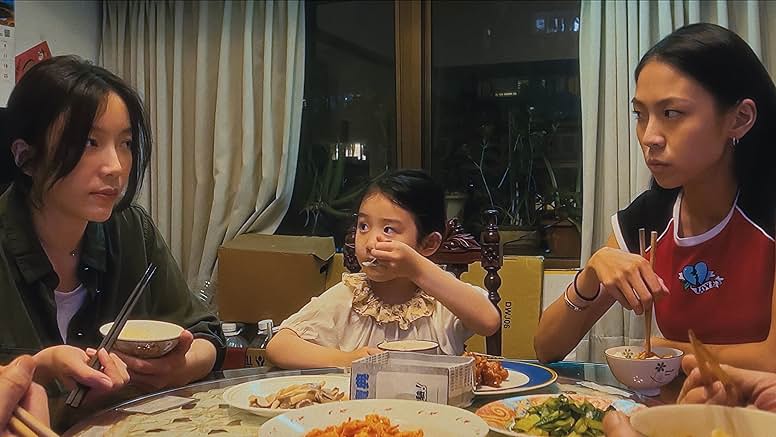
Left-Handed Girl finds its emotional power in the fragile triangle between a mother and her two daughters. While the story is seen through the eyes of the younger child, the film is deeply shaped by the relationship between the mother Shu-Fen and the older sister I-Ann, and how their choices and wounds quietly define the child’s world.
The mother Shu-Fen, played by Janel Tsai, is a woman hardened by survival. She is strict, controlling, and emotionally distant, but never written as a villain. Her authority comes from fear, exhaustion, and a lifetime of compromise. Love, in her world, is expressed through discipline and pressure rather than tenderness. The film treats her with empathy, showing how control becomes a language when softness feels like a luxury she cannot afford.
The older sister I-Ann, played beautifully by Shih-Yuan Ma, is the quiet emotional core of the film. She carries awareness that the younger child does not yet have. I-Ann understands the rules of the world too well, and that knowledge weighs heavily on her. Shih-Yuan Ma gives a restrained, deeply human performance filled with suppressed anger, sadness, and longing. She is both a shield for her sister and a mirror of what the future might look like.
The younger sister I-Jing, played by Nina Ye, absorbs everything silently. She watches how her mother controls, how her sister endures, and slowly learns how to adjust herself to survive. The title becomes painfully clear here. Being left-handed is not just a trait, but a symbol of correction, conformity, and quiet resistance.
Directed by Shih-Ching Tsou, Left-Handed Girl observes these women with patience and compassion. I loved this film deeply. It understands family not as comfort, but as inheritance. Trauma, love, fear, and resilience passed down without words. The mother and the sister are not supporting roles. They are the emotional spine of the film, and their presence is what makes Left-Handed Girl linger long after it ends.
Left-Handed Girl is one of my favorite films of the year. I would be very happy if it won the Best International Feature Oscar, even though I doubt it will. Still, it deserves to be in that conversation.
The story feels epic without being loud. It is epic because of its honesty, its emotional depth, and how carefully it builds its world and characters. Nothing is forced, nothing is exaggerated. It stays with you because it feels true. Films like this remind me why cinema matters, and why quiet stories can sometimes hit the hardest.