

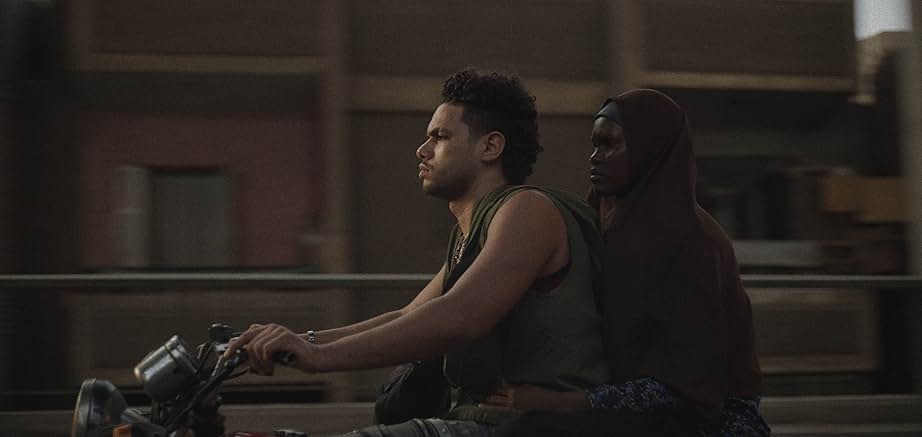
Presented at Cannes, Aisha Can’t Fly Away stands out as one of the most daring Egyptian films of recent years. Directed by Morad Mostafa in his feature debut, the film is audacious in its ambition (at times too much so, we’ll get to that later), but its boldness is impossible to ignore. It is an Egyptian feature tackling the delicate, painful space of migration, identity and survival.
Aisha (played in a haunting debut by Buliana Simon) moves through the concrete maze of Cairo, cramped buses, narrow alleyways and claustrophobic rooms. The cinematography (by Mostafa El Kashef) often employs handheld, claustrophobic framing, capturing the pressure of everyday life in migrant neighbourhoods.
It’s the kind of story that will clearly upset many Egyptians who are not ready to see this side of Cairo or admit the repression and exploitation of immigrants and refugees in the city.
What impressed me most is the film’s sense of truth. Repeated scenes of Aisha riding the microbus, always sleeping on the same side with her eyes half open or staring out the window every night. These details capture a quiet sadness that lingers. It’s the kind of sadness I attach to in cinema. Aisha is a person of few words, yet the performance speaks volumes. The camera stays close to her on her face, her body letting silence bear the weight of her pain and endurance.
That said, not everything worked for me. Some moments felt less born from necessity and more from the freedom the film allows itself (to shock, to transgress). The curses, while realistic, felt forced, as if they were used simply because they were “allowed.” The same goes for the sexual scenes, the body horror, the rashes and the bursts of gun violence. At times, it was as if the film carried a checklist of “forbidden” elements in Egyptian cinema and decided to tick them all off. These moments risk distracting from the film’s true strength: its emotional honesty and social critique.
The decision to mix realism with the sudden, surreal appearance of the ostrich adds an unexpected spark. The idea of seeing an animal and slowly transforming into it is not entirely new, I’ve come across it in other films before but here it feels unusually raw and unfiltered, carrying a weight that makes it resonate more strongly.
Despite that, I found myself admiring both the craft and the courage of Morad Mostafa. His refusal to shy away from Cairo’s hidden sides shows a filmmaker unafraid of backlash. This is a film that will divide audiences, but its very existence proves that Egyptian cinema can still be provocative and creative.
Given the conservative climate of Egyptian public discourse and film censorship, I know Aisha Can’t Fly Away will ruffle feathers. But it is precisely films like this — ones that refuse to look away — that push cinema forward.
In the end, I enjoyed Aisha Can’t Fly Away very much. It is real, it is daring, and it leaves behind images and moods that stay with you.