

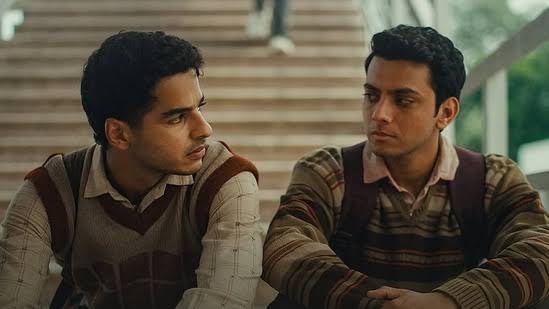
Directed with quiet intensity by Neeraj Ghaywan, it follows two young men, one Hindu, one Muslim, from a small village who dream of joining the police force. Not for glory, not for power, but for something far more fragile: dignity.
Both men are bound by the same hunger, to escape the mud of their fathers’ labor, the cracked heels of their mothers, the silence of a system that never expected them to rise. Yet the film isn’t about success or failure. It’s about what happens when the world tells you that you don’t belong, even in your own home.
One of them, Mohamed Shoaib (played by the incredible Ishaan Khatter) lives with a father who dreams of sending him to Dubai but he wants to belong to the soil that holds the bones of his grandparents and their grandparents before them. His father can no longer work because of a damaged knee, so Mohamed takes a temporary job as an office boy, fetching water and printing copies, enduring the quiet humiliations of a racist boss who doesn’t want him to fill his water bottle.
The only thing that keeps him steady is his friendship with Chandan Kumar, a Hindu born into a caste that guarantees him neither respect nor peace. Between them runs a tenderness rarely shown in Indian cinema — two men who understand each other’s pain without ever needing to explain it. Even Chandan, though Hindu, suffers from a quieter form of discrimination, the invisible walls of caste.
The main theme is injustice. Every secondary character feels real. Chandan’s sister leaves school to work; his mother’s feet are split open from years of labor, and she recalls how her own mother’s were worse. Janhvi Kapoor, as Chandan’s girlfriend, adds warmth and quiet strength, while Shoaib’s father embodies an entire generation’s broken dream.
When one of the two friends passes the police exam and the other fails, the film reaches its quiet tragedy and we see what the world is preparing for both of them.
Homebound is epic in emotion but intimate in scope. It shows how caste, class and faith divide, yet how friendship can still be the purest act of resistance.
And what makes it visually unforgettable is Ghaywan’s use of the camera. Each still frame could stand alone, a photograph full of life, pain, and grace. The cinematography turns everyday settings into living portraits: the glow of afternoon light on a broken wall, a rusted scooter against a field, the faces of people who have endured too much. Every image breathes with the soul of the place.
There are no villains in Homebound. Only people shaped by centuries of injustice. And that is what makes it heartbreaking.
What gives Homebound even greater weight is the courage behind it. In today’s India, where divisions of religion and identity run deeper than ever, making a film like this is itself an act of bravery. It doesn’t shout or accuse, it simply shows truth, and that truth is powerful enough to disturb. Homebound reminds us of cinema’s highest purpose: to be the light at the end of the tunnel.
When Muslims feel unheard, when Hindus are painted in broad strokes, films like this become essential. They don’t take sides: they hold up a mirror and ask what kind of country we still want to be.
A masterpiece about belonging, dignity, and the impossible dream of equality.
I watched many international films submitted to the Oscar’s this year and I know no one is talking about this film and I really don’t know why because this film is way better than ones everyone is talking about.