

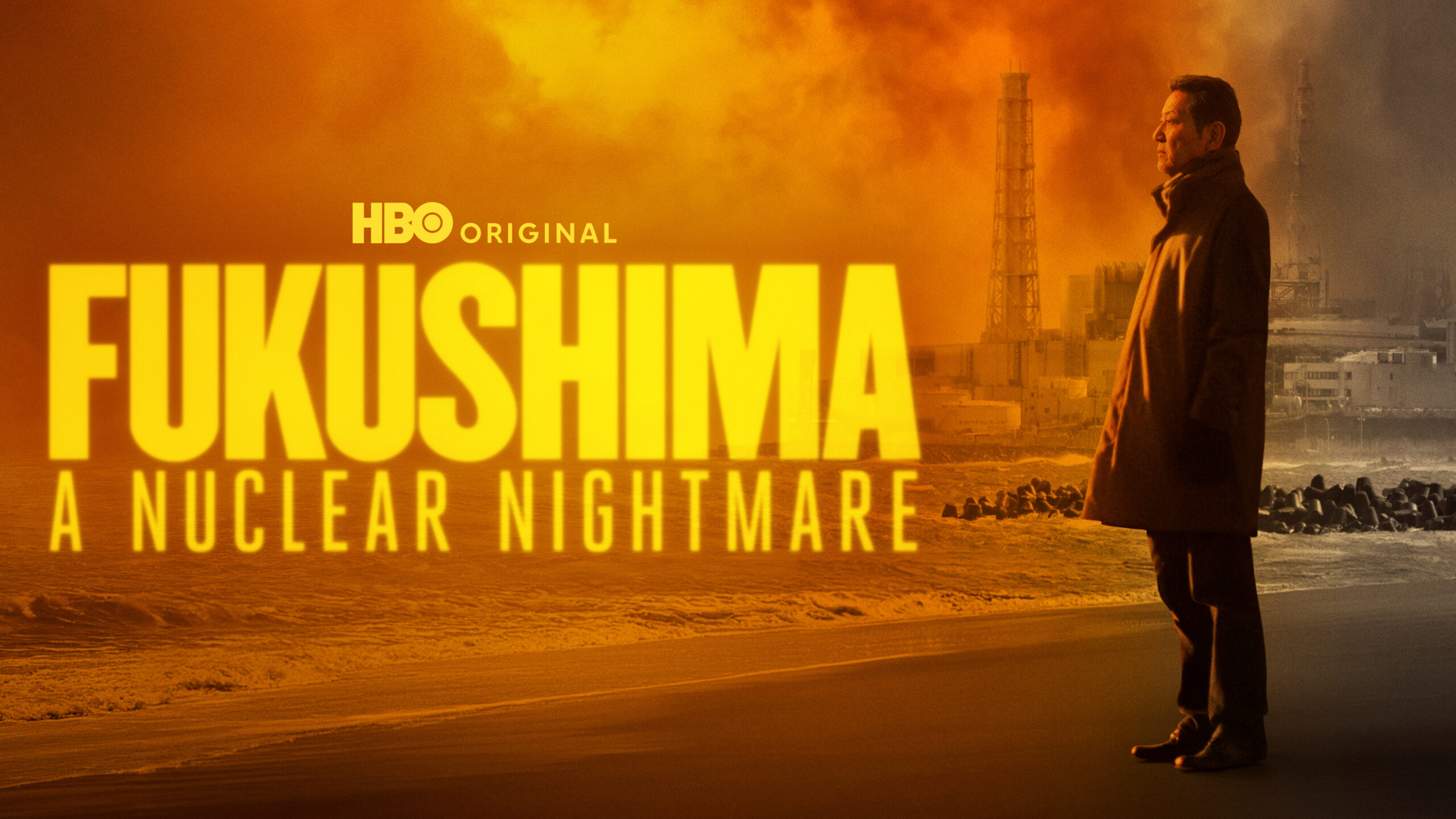
The Human Cost of a Disaster That Was Always Coming
Directors: James Jones & Megumi Inman | 90 minutes | Mar 10 | Documentary
There is a moment near the beginning of Fukushima: A Nuclear Nightmare when the film shows you an old promotional cartoon in which a friendly animated character explains to Japanese children that nuclear power is clean, safe, and good for everyone. It is the kind of image that, in 2026, should not be funny. It is not funny. It is the setup for everything that follows: the long, unbroken line from that cartoon to the morning of March 11, 2011, when the Tōhoku earthquake sent a fifteen-metre tsunami crashing through the seawalls of the Fukushima Daiichi Nuclear Power Plant and the world discovered what happens when the confidence of an industry meets a force it was never designed to withstand.
Fukushima: A Nuclear Nightmare is directed by James Jones, a prolific, BAFTA and Emmy award-winning documentary filmmaker, and Megumi Inman, and it has become, unexpectedly, one of the most-watched documentaries on HBO Max since its US release in March 2026. That visibility matters, because this is a film that is explicitly about what happens when powerful institutions decide the public does not need to know the full truth. The film’s greatest achievement is making you feel that argument rather than just hear it stated.
March 11, 2011
On that morning, Japan experienced its most powerful earthquake in a thousand years. The Tōhoku earthquake lasted several minutes, triggered a catastrophic tsunami, and killed over 18,000 people. It also disabled the cooling systems of three reactors at Fukushima Daiichi, reactors operated by Tokyo Electric Power Company (TEPCO), and began nine days of crisis that came closer to nuclear annihilation than most people alive today understand.
The film reconstructs those nine days in near-real-time detail. Its primary witness is Ikuo Izawa, a shift supervisor in the control room at the moment the tsunami hit. Izawa walks us through those days with a clarity and a restraint that is more devastating than any dramatic performance could be, the voice of a man who has replayed every decision many thousands of times and has come to some kind of accommodation with what happened, without ever fully resolving it. Alongside him, engineer Katsuaki Hirano and a series of government officials, journalists and American nuclear consultants provide what becomes a remarkably complete picture of an institutional failure that was simultaneously a series of individual heroic acts.
What the film makes vivid, above everything else, is scale. Japan came, in those nine days, within a series of decisions and a great deal of luck from an outcome that would have required the evacuation of Tokyo (37 million people). That is not a hypothetical floated by the film for dramatic effect. It is the considered judgement of the officials who were in the room.
The Company and Its Culture
After Hiroshima and Nagasaki, the American government promoted civilian nuclear energy partly as a way to rehabilitate the atom’s image, and the Japanese government embraced it eagerly. TEPCO became the utility operator and built its identity around the argument that nuclear power was perfectly safe. This was not just a marketing position. It became, over decades, a culture — one in which it was not possible to acknowledge safety concerns without undermining the entire project.
The specific failure at Fukushima is not complicated. TEPCO had been warned, multiple times, that the seawalls protecting the plant were insufficient to withstand a major tsunami. The company did not act on those warnings. When the tsunami came, the cooling systems failed, and the consequences unfolded across nine terrifying days. The film is careful, meticulous, and damning in its account of this sequence.
What makes it more than a forensic account of institutional failure is that TEPCO, in 2026, still has not fully acknowledged its responsibility. The company continues to conceal information about the incident. The film does not flinch from stating this. Its final section, which brings the story to the present moment including the ongoing discharge of treated water into the Pacific, and the extraordinary fact that nuclear power is, once again, being promoted globally as a clean energy solution land with the weight of genuine alarm.
The Fukushima 50 — and the Truth About That Number
One of the film’s most striking revelations is the story of the ‘Fukushima 50’, the workers who stayed at the plant during the crisis, widely described in the international press as a group of fifty selfless heroes who sacrificed themselves to prevent the worst. The reality, the film reveals, was both more complicated and more human than the legend. There were not fifty. There were more like sixty-nine. They were not volunteers choosing sacrifice. They were workers who could not leave, partly because of duty, partly because leaving would have meant abandoning colleagues, and partly because the situation made orderly departure impossible.
The film is explicit that these men are heroes. It is equally explicit that they should never have been put in a position that required heroism.
What the Film Does
At ninety minutes, Fukushima: A Nuclear Nightmare is a lean, controlled piece of work. Jones and Inman make strong choices: the archival footage of the earthquake and tsunami is overwhelming in the way it must be, and the film does not shy from the scale of the natural disaster before pivoting to the human and institutional disaster that followed. The music by Uno Helmersson serves the material without sentimentalising it.
The film’s leading contributor Ikuo Izawa describes it as ‘a small record of what really happened.’ That honesty is both its strength and its limitation.
What it handles extraordinarily well is the nine days of the crisis itself, and the question of why those nine days happened at all. On that question it is clear, unflinching, and important. The film does not let the heroism of the workers obscure the culpability of the institution. It holds both things simultaneously and refuses to let either cancel the other.
Why Now
The timing of this film is not accidental. The global demand for energy is rising, accelerated by the electricity requirements of AI data centres and by the transition away from fossil fuels. Nuclear power is being rehabilitated in multiple countries, including Japan, where there are active plans to restart reactors and build new ones. The film’s implicit argument, made explicitly in its final minutes, is that this rehabilitation is being conducted with exactly the same institutional confidence that produced Fukushima.
TEPCO knew there was a problem. They chose not to act. Every institution that promoted nuclear power as risk-free knew, at some level, that this was not completely true. They chose to say otherwise. The film’s value in 2026 is precisely that it documents what those choices cost, in human terms, with the testimony of the people who bore that cost most directly.
Fukushima: A Nuclear Nightmare is a perfect documentary. It is the most important film in the first quarter of 2026, and the fact that it reached the top of the HBO Max documentary charts suggests that audiences understand this, even if they could not have told you why they needed to watch it before they did. The world is heading back toward nuclear power with the same confidence that produced the cartoon at the film’s beginning. Ikuo Izawa’s testimony is the record of what that confidence costs when it is wrong.