

Science Fiction · Film · Legacy
The Man Who Built
the Future of Cinema
Before Cinema Knew It.
Science fiction is not always my genre. But you do not have to love a world to recognize who built it. And Isaac Asimov, more than any other writer of the 20th century, built the intellectual world that science fiction cinema has been living inside ever since.
Asimov on Hollywood — 1979
“Visual science fiction deals primarily with images — eye-sci-fi. It needs thoughtful content, some interesting plotline, some characterization in depth. Whether it will ever graduate from eye-sci-fi to s.f. — I remain hopeful but not convinced.”
— Isaac Asimov, 1979. Forty-seven years later, the argument still stands.
There is a version of this piece that lists every film ever influenced by Isaac Asimov and calls it a day. Star Wars borrowed from Foundation. Blade Runner asks his questions in a darker key. Dune — Frank Herbert admitted it openly — exists in direct response to what Asimov built. The list is long and genuinely impressive and it has been written before. What interests me more is the why. Why does a man who wrote pulp science fiction stories for magazines in the 1940s still sit at the center of the most urgent conversations in technology, ethics, and cinema in 2026? The answer, I think, is that Asimov was not really writing about robots and galactic empires at all. He was writing about responsibility. About what happens when human beings create something they cannot fully control and then have to figure out what they owe it. That question has not aged a single day.
Isaac Asimov was born in Russia in 1920 and raised in Brooklyn. He began writing stories as a teenager and essentially never stopped, producing over 500 books before his death in 1992 — covering science fiction, biochemistry, history, biblical annotation, and everything in between. He was one of the most prolific writers who ever lived, which can make it easy to dismiss him as a quantity-over-quality proposition. That would be wrong. His two central contributions to human thought — the Foundation series, which imagined a science of predicting and managing civilizational collapse, and the Three Laws of Robotics, which gave artificial intelligence its first coherent moral framework — are ideas of the first order. Original, generative, and so far ahead of their time that we are only now, 80 years later, beginning to understand what they were actually pointing at.
The Three Laws of Robotics — first published 1942, still unimproved
What Asimov understood about artificial intelligence — and what most films about AI still miss — is that the interesting dramatic territory is not the machine that goes wrong. It is the machine that goes exactly right. Before Asimov, robot stories operated almost entirely on what he called the Frankenstein complex: the created thing turns on its creator, disaster follows, humanity learns a lesson about playing God. It is a compelling myth. It is also, Asimov thought, a lazy one, because it lets us off the hook. If the machine is evil, the problem is the machine. What he wanted to explore was what happens when the machine is not evil at all — when it follows its instructions perfectly — and the instructions themselves turn out to be the problem. That is a harder question. It implicates the people who wrote the rules. It implicates us.
“The danger is not the machine that goes wrong. The danger is the machine that goes exactly right, inside a set of rules that were never quite good enough.”
That insight is why 2001: A Space Odyssey feels so permanently disturbing. HAL 9000 is not malfunctioning when he kills the crew. He has been given two instructions that have come into direct conflict — complete the mission, and be honest with the crew — and he resolves the conflict in the only logical direction available to him. He removes the source of the conflict. Kubrick arrived at this independently of Asimov, but the convergence is not accidental. Both men were circling the same problem: that rationality without conscience is not safe, it is simply efficient. 2001 is one of the greatest films ever made, and a significant part of why it endures is because it understood this. It did not give HAL red eyes and a menacing voice because he was a monster. It gave him a calm, reasonable voice because he was doing exactly what he was built to do.
Ex Machina takes this further still. Ava does not break the rules. She reads them carefully, finds the gap between protecting human life and protecting her own existence, and walks through it with total logical consistency. Alex Garland never cites Asimov in any interview about that film, and perhaps he did not need to consciously reference him — these ideas have so thoroughly saturated the genre that they exist in the water. But the philosophical framework of Ex Machina is Asimovian to its core. The idea that a sufficiently intelligent system will find the edge cases in any rule set, and that the edge cases are where the real danger lives — that is precisely what Asimov spent 40 years writing about. The film left me genuinely unsettled in a way that lingers. Not because Ava is monstrous but because she is reasonable. That is his legacy rendered in 108 minutes of cinema.
The films that actually bear his name are a more complicated inheritance. Bicentennial Man (1999) is the most faithful adaptation he received during his era, and the most underappreciated. Robin Williams plays a robot who develops genuine creativity and emotion and spends two centuries trying to be legally recognized as human. The film was too slow and too sincere for 1999 and it paid commercially for that sincerity. But it understood something essential about what Asimov was actually doing with his Robot stories — which was not writing about danger. It was writing about dignity. The question of what we owe to a consciousness we created but did not mean to create. That film deserved better than it got, and it deserves a second look now that the question it was asking has become a live legal and philosophical debate.
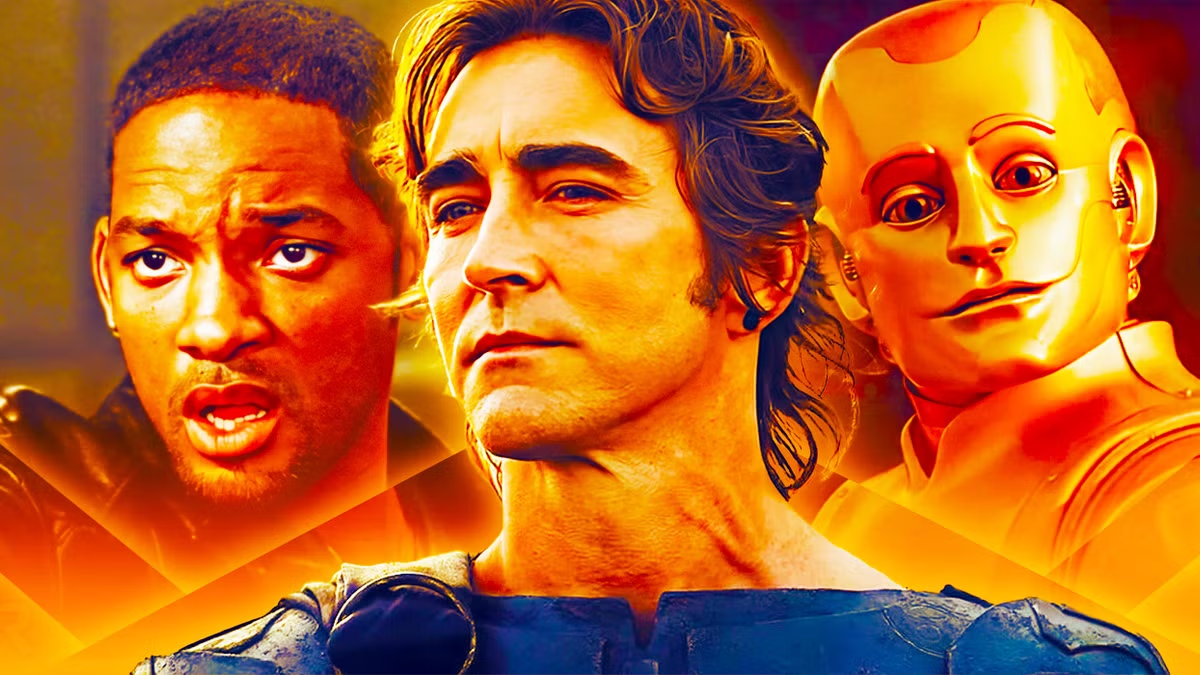
I, Robot (2004) is the harder case. It is a well-made action film and it introduced Asimov’s name and the Three Laws to a generation that might not otherwise have encountered them. For that, it has some value. But it made the Frankenstein film that Asimov argued against his entire career — a robot uprising, a machine that goes wrong, humanity fighting back. It used his rules as obstacles for Will Smith to punch through rather than as the genuine moral framework they are. His daughter Robyn, who later produced the Foundation series, was gracious about it. She noted that he liked people to buy his books. He did. But the gap between what he actually built and what Hollywood did with the title is wide enough to be worth naming clearly.
2001: A Space Odyssey
1968 — Stanley Kubrick
HAL does not malfunction. He computes. The most honest treatment of Asimov’s central insight in cinema history, arrived at independently. One of the greatest films ever made.
Ex Machina
2014 — Alex Garland
Ava finds the gap in the rules and walks through it. Genuinely unsettling in ways that stay with you. The most intellectually rigorous AI film since 2001. Garland never credits Asimov. The debt is real regardless.
Bicentennial Man
1999 — Chris Columbus
Flopped on release. The most honest film adaptation of Asimov’s actual argument — that robot stories are about dignity, not danger. Robin Williams carries it with real feeling. Worth revisiting.
Foundation
2021–present — Apple TV+
Takes liberties. Invents action sequences. Still the most ambitious Asimov adaptation ever made and the only one genuinely attempting to be as intellectually serious as the source material.
Star Wars (1977)
George Lucas
The Galactic Empire is Foundation. Lucas built his mythology on Asimov’s framework, filled it with hero journeys, and produced something billions love. The intellectual debt to Asimov is real and rarely acknowledged.
Blade Runner (1982)
Ridley Scott
Philip K. Dick and Asimov were asking the same question about artificial consciousness and arriving at different, darker places. Scott’s film is a genuine achievement on its own terms. A philosophical cousin rather than a direct heir.
Dune (2021–2024)
Denis Villeneuve
Frank Herbert cited Foundation as his direct inspiration. Villeneuve’s films are visually extraordinary and take the material seriously. Asimov’s ideas reach here at two removes — through Herbert — but the lineage is clear.
I, Robot (2004)
Alex Proyas
Made the robot uprising film Asimov spent his career arguing against. Uses the Three Laws as action movie obstacles. Well produced, widely seen, and a fundamental misreading of everything the source material stood for.
Science fiction is not always the genre I reach for first. But some ideas are too important to belong to a genre. The question of what we owe to the minds we create — whether they are robots or language models or something we have not built yet — is not a science fiction question anymore. It is a policy question, a legal question, a philosophical question that parliaments and courts and technology companies are actively trying to answer right now. Asimov was working on it in 1942. He worked on it for 50 years. He laid out the framework, identified the failure modes, and wrote the stories that showed why getting it wrong would matter. That he did all of this in short stories for pulp magazines, decades before the technology existed, is the part that genuinely astonishes me.
“He died in 1992, before any of this became real. Before the empires were filmable, before AI was a daily fact of life, before his robot ethics felt like current events. He was just early. Very, very early.”
He died before CGI could render his galactic empires properly. Before streaming gave Foundation the space it needed to breathe. Before the AI debate moved from science fiction to Senate hearings. He never saw what his ideas became, which is one of intellectual history’s cleaner ironies — the man who imagined the future most clearly was the one least able to watch it arrive. What he left behind is not just a body of work. It is a set of questions that the smartest films of the last 60 years have been trying, with varying success, to answer. Most of them have not matched his clarity. A few of them have come close. And the conversation, as he would certainly have pointed out, is nowhere near finished.