

The World Needs Jury Duty More Than It Knows
Three years after Ronald Gladden became an unlikely TV folk hero, Amazon's one-of-a-kind prank series returns with a new setting, a new face, and the same quietly devastating thesis: most people, given the chance, choose to be good.
There is a cynicism baked into most of what we call "reality television." It operates on the assumption that people, left to their own devices and pointed at a camera, will perform their worst selves. They will lie, backstab, humiliate. We will watch. We will feel superior. Season finales will arrive with someone in tears and an audience in stitches. Jury Duty has spent two seasons dismantling that entire model — and doing it gently, almost tenderly, as if it doesn't want to embarrass the genre it's quietly making obsolete.
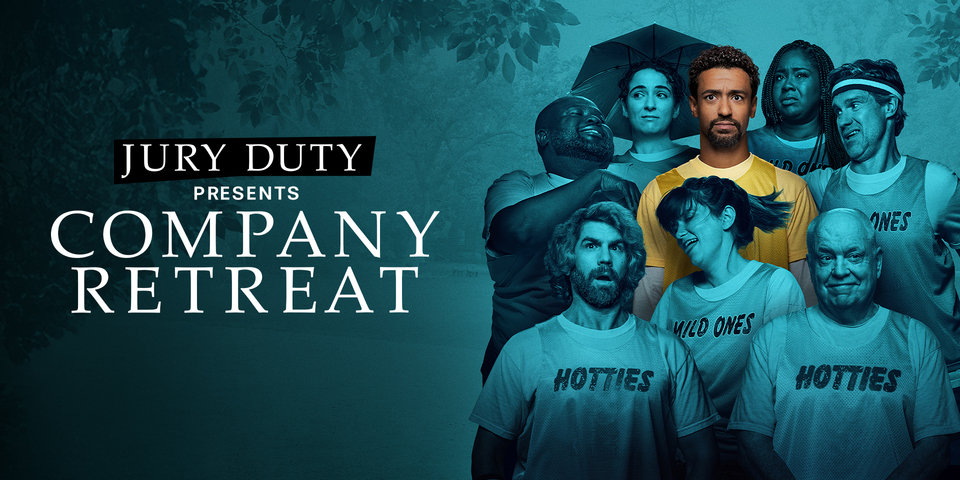
The premise, if you somehow missed it: one real, unsuspecting person is placed inside a fully constructed fiction, surrounded entirely by actors and improv performers. Every colleague, every eccentric character, every crisis — staged. The lone civilian has no idea. And the cameras are rolling the whole time. In Season 1, that civilian was Ronald Gladden, a solar panel contractor who became an unlikely television hero for the radical act of just being decent. In Season 2 — subtitled Company Retreat — it's Anthony Norman, a 25-year-old from Nashville who believes he's landed a temp job at a small hot-sauce company called Rockin' Grandma's, and has been roped into their annual company retreat as part of a documentary about small businesses.
Anthony doesn't know any of it is fake. And watching him not know — watching him show up, take ownership, champion his colleagues, and refuse to become cynical even as chaos escalates around him — is, somehow, one of the most moving things on television right now.
"Watching Anthony choose, again and again, to be the best person in the room — it keeps hitting different. That's the whole show. That's the whole thesis."
The most obvious question hanging over Season 2 was whether the format could survive a transplant. The courtroom of Season 1 had a natural dramatic architecture — jury deliberations, a plaintiff, a verdict — that gave everything stakes and structure. A company retreat is looser, messier, more diffuse. It shouldn't work as well. And yet.
Swapping the jury box for a corporate off-site turns out to be a genuinely inspired move. The workplace setting unlocks a whole new register of comedy — team-building exercises gone wrong, a chaotic talent show, educational seminars that are anything but — while also giving Anthony something Season 1 didn't quite give Ronald: actual agency. Anthony isn't just absorbing the chaos. He's managing it. He's captain-ing it. He's the kind of guy who, when things fall apart, starts cheerleading. He gets promoted, mid-chaos, to something called "Captain Fun," and he takes the title seriously in a way that shouldn't be as endearing as it is.
Where Ronald Gladden's decency was essentially passive — a kind of baseline goodness that the show celebrated — Anthony's goodness is active. He works. He problem-solves. He takes ownership of people he met three days ago. It makes him a different kind of protagonist, and arguably a more interesting one to spend eight episodes with.
Season 2: Anthony Norman — real person, temp worker from Nashville — starts a job at fictional hot-sauce company Rockin' Grandma's. Every colleague, every scenario, and the entire company retreat is constructed by the production. Anthony is the only person who doesn't know.
Let's talk about Anthony. He was chosen from a pool of ten thousand applicants — people who believed they were applying for a documentary about small businesses. What the producers found was someone whose instinct, when placed in a strange situation, is not suspicion or withdrawal, but enthusiasm and care. He shows up for people. He notices when someone is struggling. He makes things better. He does this constantly, reflexively, as if it's simply the only way he knows how to exist in a room.
He is not naive. He clocks the weirdness around him. There are moments when something clearly doesn't add up, and you can see him process it — and then decide, essentially, that it doesn't matter. That his job is still to do his job, and to look out for the people around him. That choice, made repeatedly and without fanfare, is what the show is really about.
The format has always understood something that most television doesn't: goodness is interesting. Not goodness as a character trait to be tested and found wanting, not goodness as a setup for a fall — but goodness as a thing worth watching, worth spending time with, worth celebrating. In a media landscape that runs on conflict, provocation, and the performance of dysfunction, Jury Duty insists that watching someone be genuinely kind is riveting. It's right.
It would be dishonest not to note what the second season doesn't quite have. James Marsden was a revelation in Season 1 — a genuine movie star fully committed to making himself ridiculous, playing his own ego at a pitch that somehow never tipped into cruelty. Nobody in the Company Retreat cast delivers anything close to what Marsden brought. The ensemble is strong, the improv is tight, the characters are vivid — but there's no single scene-stealer at that level.
Some of the novelty has also worn off. When you know the format, when you know that every strange thing is deliberate and every eccentric co-worker is a performance, there's a ceiling on how disorienting it can feel. Season 1 had the advantage of being genuinely unknown. Season 2 operates in a world where viewers arrive already in on the joke. That changes the texture of the watching experience in ways that are real, even if they're not fatal.
What the second season gains, however, is ambition. The production is larger, the scenarios more elaborate, the supporting cast more densely layered. The season builds properly — it earns its emotional moments rather than just stumbling into them. By the final episodes, when the reveal approaches and you know what's coming, the stakes feel genuine. You worry for Anthony. You want it to land right for him.
It does.
"This show understands something most television refuses to: goodness is not a setup. It is not a flaw waiting to be exposed. It is simply good. And it is riveting to watch."
There's a version of this show that's just a prank series — well-executed, occasionally funny, ultimately disposable. Jury Duty is not that show, and hasn't been since the first episode of its first season. What it's actually doing, underneath the improv and the manufactured chaos, is running an experiment in human nature. It finds someone ordinary. It puts them under pressure. It watches what they do.
Both times now, the answer has been the same. They help. They connect. They choose generosity when selfishness would be easier, patience when irritation would be justified. They become, in real time, the best version of themselves — not because they know anyone is watching, but because that's apparently just who they are.
That finding feels significant. The world Anthony Norman is living in — the one outside the Rockin' Grandma's retreat — is not particularly optimistic right now. The cultural atmosphere is saturated with suspicion, grievance, and the performance of contempt. Into that, Jury Duty drops a young man from Nashville who just wants to do his job well and make sure everyone around him feels seen. And it dares you to find it boring.
You won't.
Jury Duty Presents: Company Retreat is not a lesser sequel — it's a confident second proof of concept. Different setting, different person, same extraordinary conclusion: given the right circumstances, people are remarkable. In 2026, that's not just good television. It's almost radical.