

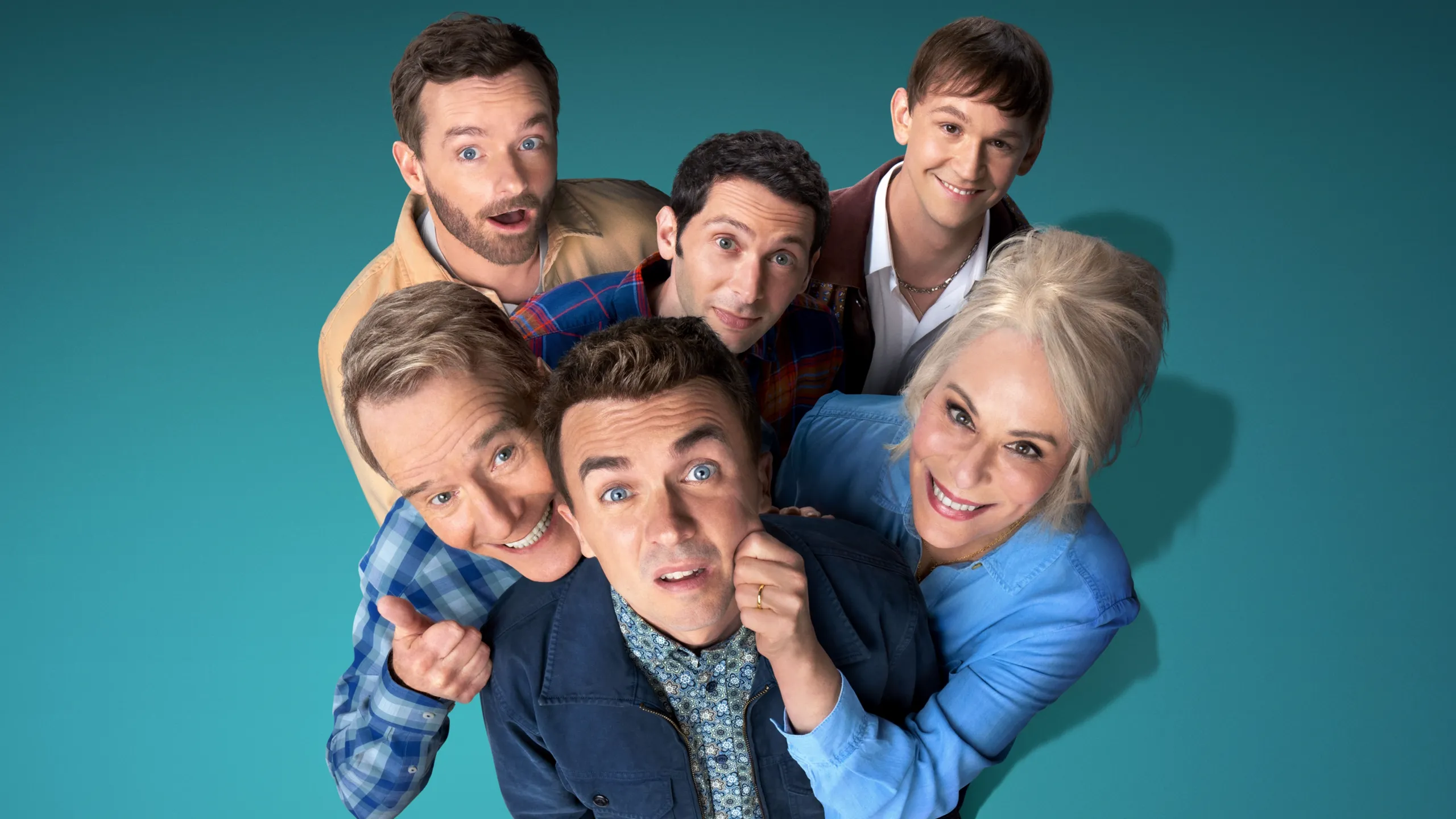
Twenty Years On, Life Is Still Wonderfully, Chaotically Unfair
Hulu's four-episode revival is warmer than it has any right to be — leaning on nostalgia with full self-awareness and delivering, in its third hour, a Bryan Cranston performance that the Emmy season cannot afford to ignore.
- Platform
- Hulu / Disney+
- Premiered
- April 10, 2026
- Episodes
- Four (all available now)
- Created by
- Linwood Boomer
- Directed by
- Ken Kwapis
- Starring
- Frankie Muniz, Bryan Cranston, Jane Kaczmarek, Christopher Masterson, Justin Berfield
- New cast
- Keeley Karsten, Kiana Madeira, Caleb Ellsworth-Clark
- Rotten Tomatoes
- 79% (critics, at time of publication)
There is a specific, slightly embarrassing joy in pressing play on a show you watched as a teenager and hearing that theme music — Yes! No! Maybe! I don't know! Can you repeat the question? — and feeling, despite everything, unambiguously happy. Malcolm in the Middle: Life's Still Unfair, Hulu's four-episode revival of the 2000–2006 Fox sitcom, earns that joy. Not effortlessly, and not without caveats, but genuinely. Twenty years later, the Wilkerson family is still capable of dragging a smile out of me that I wasn't entirely planning to give.
I'll be honest: I went in sceptical. Revival television has a poor track record. It tends to mistake familiarity for storytelling, letting the presence of beloved faces do the heavy lifting while the actual scripts coast. Life's Still Unfair is not entirely immune to this temptation — its four episodes lean on nostalgia as a structural device as much as an emotional one. But the difference here is that the nostalgia feels earned. These aren't actors in a museum. They are people who understand exactly what made this show work, and who have, in the twenty years since, lived enough to bring something real back to it.
The Setup
The revival's premise is elegantly simple: Malcolm — now approaching 40, with a daughter of his own named Leah (the sharp, fourth-wall-breaking Keeley Karsten) and a girlfriend named Tristan (Kiana Madeira) — has spent years keeping a deliberate distance from his family. When Hal and Lois demand his presence for their 40th wedding anniversary party, the carefully maintained walls come down. That's it. That's the engine. The chaos, as ever, generates itself from there.
The Leah character is the revival's most satisfying structural decision: she inherits Malcolm's ability to speak directly to the audience, and in doing so allows the show to comment on its own legacy without becoming self-congratulatory about it. When Leah looks at the camera with the same slightly stunned bewilderment that Frankie Muniz once did, it doesn't feel like a gimmick. It feels like the show making an honest argument that some family traits skip no generations whatsoever.
Episode by Episode
Episode 1"Still Crazy After All These Years"
The first episode does what any good revival episode must: it catches us up without boring us to death. The writing is quick — we learn Malcolm's situation (happy, distant, secretly a father) through action rather than exposition, and within fifteen minutes the family machinery is in motion. Kaczmarek's Lois is precisely where we left her: a force of nature operating at a frequency no one else in the room can quite hear. The scene in which she discovers Malcolm has been concealing Leah's existence is the episode's best, escalating with that specific Lois logic in which the more outrageous she becomes, the more correct she somehow turns out to be.
Episode 2"The Wilkerson Method"
The second episode is the shakiest of the four — structured a little too loosely, and carrying the unfortunate weight of having to reintroduce Francis (Christopher Masterson), Reese (Justin Berfield), and the new Dewey (Caleb Ellsworth-Clark, stepping admirably into an impossible pair of shoes, filling the void left by the absent Erik Per Sullivan). The ensemble juggling act creaks slightly. But there are moments — a Reese-Dewey sequence involving a kitchen disaster that escalates in four perfect beats — that remind you exactly why this show was a comedy masterclass. Berfield, for his part, has not missed a step.
Cranston takes Hal into genuinely strange emotional territory and comes back with something that feels less like comedy and more like confession — the funniest confession I've watched this year.
— Youssef, Youssef ReviewsEpisode 3"The Self-Therapy Session"
This is the one. If the revival is remembered for a single thing, it will be Episode 3 — specifically the twenty-minute arc in which Hal, stung by the news that Malcolm considers his parents a burden on his life, embarks on a drug-fuelled attempt at self-therapy before the anniversary party. Bryan Cranston commits to this sequence with a total physical and emotional abandon that is, frankly, extraordinary to watch. He is simultaneously hilarious and heartbreaking: a man who built his entire identity around being a present, enthusiastic father confronted with the possibility that enthusiasm was never quite enough.
The scene calls for Cranston to do things that are beneath dignity and beyond embarrassment, and he does all of them with the precision of a craftsman who knows exactly how much is too much and stays precisely one millimetre short of it. This is physical comedy at its most controlled, and emotional performance at its most unguarded. I have not seen a better ten minutes of television comedy acting this year, and I suspect I will not.
Emmy Watch — Outstanding Lead Actor in a Limited Series?
Cranston is already a seven-time Emmy winner (including three for Breaking Bad as Outstanding Lead Actor in a Drama Series). His Episode 3 work here is in a different category of television entirely — and a different Emmy category, specifically Outstanding Lead Actor in a Limited Series or Movie. He is, in my view, the frontrunner for that nomination off the strength of this episode alone. The performance is the kind that voters respond to: technically demanding, emotionally enormous, and carried by someone whose previous Emmy record makes every subsequent performance a referendum on whether he has lost a step. He has not. If anything, twenty years of dramatic work has made his comedy sharper rather than softer. Whether the Academy classifies Life's Still Unfair as a limited series or a comedy special will determine the category — but either way, this performance deserves to be in the room.
Episode 4"The Party"
The finale brings everything together at the anniversary party itself, and it works — not because it resolves everything neatly (it doesn't) but because it locates exactly the right emotional register for these characters in middle age: not redemption exactly, but recognition. Malcolm doesn't forgive his family for being what they are. He acknowledges, finally, that they couldn't have been otherwise. And that this is not the same as not loving them. The final scene, between Muniz and Cranston, is the best thing Muniz has done since the original series, and it earns the emotion it's asking for.
What Worked — And What Didn't
The revival's greatest strength is that it trusts its actors. Kaczmarek, in particular, is given material that complicates Lois rather than simply repeating her — there is a scene in the third episode, just a minute long, where she sits alone in the kitchen and the camera stays on her face without the comedy buffer, and Kaczmarek does something quietly devastating with it. The show has always known that Lois was the emotional architecture beneath the chaos. It remembers this here.
The weakness is what it has always been for revival television: the episode count. Four episodes is both too few and slightly too many. The Dewey replacement lands awkwardly; Francis's arc feels truncated; some of the new cast (particularly Kiana Madeira as Tristan) are given too little to do and too little time to do it in. The show would have benefited from either two episodes or six. At four, it sits in an uncomfortable middle zone where some threads are given less than they require and others are given slightly more than they can carry.
But here is the thing about Malcolm in the Middle: Life's Still Unfair — I enjoyed it. Genuinely, warmly, nostalgically enjoyed it, in the specific way that is different from admiring something and different again from merely recognising something. It made me feel twenty-five years younger for four hours, and then it made me feel the weight of those twenty-five years, and then it made me laugh again. That is a more sophisticated emotional manoeuvre than most four-episode limited series can manage, and it deserves credit.
The Wilkerson family has not changed. Life is still unfair. And somehow, twenty years later, that is still exactly what the doctor ordered.
Warmer, stranger, and more emotionally honest than it needed to be
Life's Still Unfair is not a reinvention, and it doesn't pretend to be. It is a reunion — executed with enough intelligence and enough genuine feeling to justify its existence. Four good episodes, one great one, and a Bryan Cranston performance in Episode 3 that is worth the price of a Hulu subscription by itself. The nostalgia is real. So, unexpectedly, is the rest of it.
All 4 episodes available
Rated TV-14 · Approx. 28 min per episode