

I walked into this film not knowing much about it. I walked out with a big stupid smile on my face and tears I didn’t see coming. That doesn’t happen very often. This is my favourite film of the year.
Le città di pianura — which means The Cities of the Plain in Italian — is a small Italian film directed by Francesco Sossai. It played at Cannes 2025 and won two awards at the Thessaloniki Film Festival: Best Film and Best Actor. Most people probably haven’t heard of it. That needs to change.
What It’s About
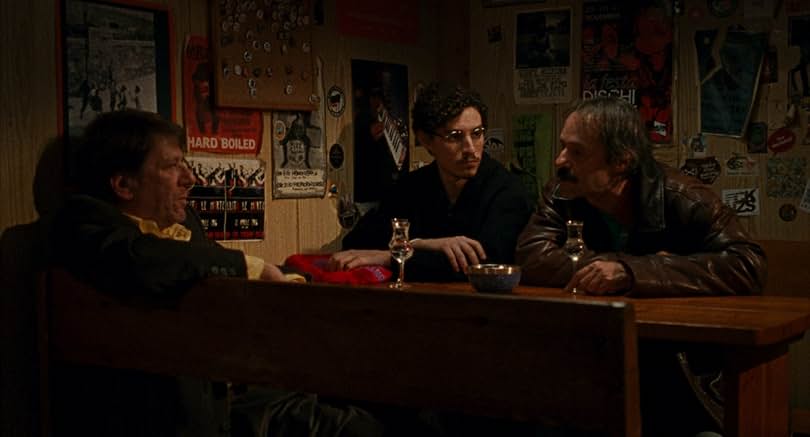
Two middle-aged guys — Carlobianchi and Doriano — spend their days going from bar to bar across the flat plains of northeast Italy, drinking, arguing, and talking nonsense. They are broke, loud, a bit ridiculous, and completely sure of themselves about everything. Their old friend Genio is coming back from Argentina the next day, and before he arrives they want to find some money he buried before he left years ago.
Along the way they meet Giulio, a quiet architecture student who is too scared to tell a girl he likes her and not sure what he wants from life. These two older guys pull him into their night, into their arguments, into their world. And something changes in him. Slowly, quietly, it changes.
That’s it. That’s the film. No big drama, no twist, no action. Just three people in a car driving through a grey, flat part of Italy, stopping at bars, talking about life. And somehow it’s one of the best things I’ve seen in years.
The People in It
Sergio Romano and Pierpaolo Capovilla play Carlobianchi and Doriano, and they are incredible together. They feel like two guys who have known each other their whole lives and have been arguing the same argument forever and still haven’t got bored of it. There’s a scene where they try a non-alcoholic beer — the way they sniff it, taste it, look at each other, and give their verdict — I laughed out loud. It’s perfect.
But here’s the thing. These guys are funny, yes. But they’ve also had hard lives. Things didn’t work out the way they hoped. The world got smaller around them. And instead of collapsing, they just kept going. They’re still here. Still at the bar. Still arguing. That is quietly the whole point of the film.
Filippo Scotti plays Giulio and he’s brilliant at playing someone who holds himself back from life. You watch him slowly loosen up over the course of the film and it feels completely real. No big moment. No speech. Just a person becoming a little less afraid.
The Music
The whole soundtrack is by a Venetian musician called Krano. It came out as an album on Maple Death Records in November 2025 and it’s worth listening to on its own, away from the film. It’s a strange mix — folky, a bit fuzzy, kind of dreamlike. Think Bob Dylan but from a swampy Italian village. It doesn’t push the emotions at you. It just drifts alongside the film like it belongs there.
There’s a track called La Ninna Nanna — a lullaby — that plays near the end. I don’t want to say too much. But if you don’t feel something when it comes in, check your pulse.
The Ending
The film ends on the same road where it started — a quiet stretch of trees and hills in the Val Lapisina valley. Carlobianchi and Doriano drop Giulio off. Nobody makes a big speech. Nobody cries dramatically. They just say goodbye the way people actually say goodbye — a bit awkward, a bit warm, and then it’s done.
They never found the buried money. Or maybe they did, in a way, and it turned out to be something else entirely. The film is smart enough not to spell it out.
The last shot is just the road. Trees. Light. Krano’s music underneath. I sat there in my seat for a bit after the credits started. Sometimes that’s how you know a film got you.
How It Made Me Feel
From the first twenty minutes I had a smile on my face I couldn’t shake. These two guys are so funny, so alive, so completely themselves. You just want to sit with them.
Then the sadness starts to creep in. Not because anything terrible happens, but because you start to understand what these men have been through. The factories that closed. The friend who had to leave. The plans that never worked out. The way the small towns they grew up in have changed and kept changing and won’t stop. It’s the kind of sadness that feels true because it doesn’t announce itself. It just sits there.
Life does that. It doesn’t break you in one big moment. It chips at you slowly over years, and one day you look around and things are different and you didn’t even notice when it happened. This film gets that completely.
But here’s what I love most about it: it’s not sad in a hopeless way. These guys are still going. Still laughing. Still ordering the next drink. Life knocked them around and they’re still here, and that’s not nothing. That’s actually everything.
Friendship
What Carlobianchi and Doriano give Giulio isn’t advice. It’s not wisdom. It’s just company. They pull him out of his head and into the night. They show him, without meaning to, that it’s possible to lose things and still show up. To be disappointed and still care. To keep going even when you’re not sure what for.
That’s what real friendship is, I think. Not the stuff you post about. The people who are just there. Loud and annoying and always there. The film understands this completely.
Life, Man. Life.
The flat plains of the Veneto — industrial, grey, full of big superstores and factories and roads going nowhere special — are not a place you’d normally make a beautiful film about. But Sossai and his cinematographer find real beauty in it. A bar that hasn’t changed since 1974. A ditch at dusk. Two guys in a car with the window down.
The film knows the world is hard and getting harder. It doesn’t pretend otherwise. But it also says: look at these people. Look at how they’re still here. Still moving. That matters. That’s worth something.
Life breaks you. That’s just true. The question is what you do after. This film’s answer is: you find the people who are also broken, and you keep going together.
Le città di pianura is my favourite film of the year. It made me smile, it made me sad, and it made me feel like life — as hard as it is — is still worth showing up for. I don’t know what else you can ask from a film.
★★★★★