

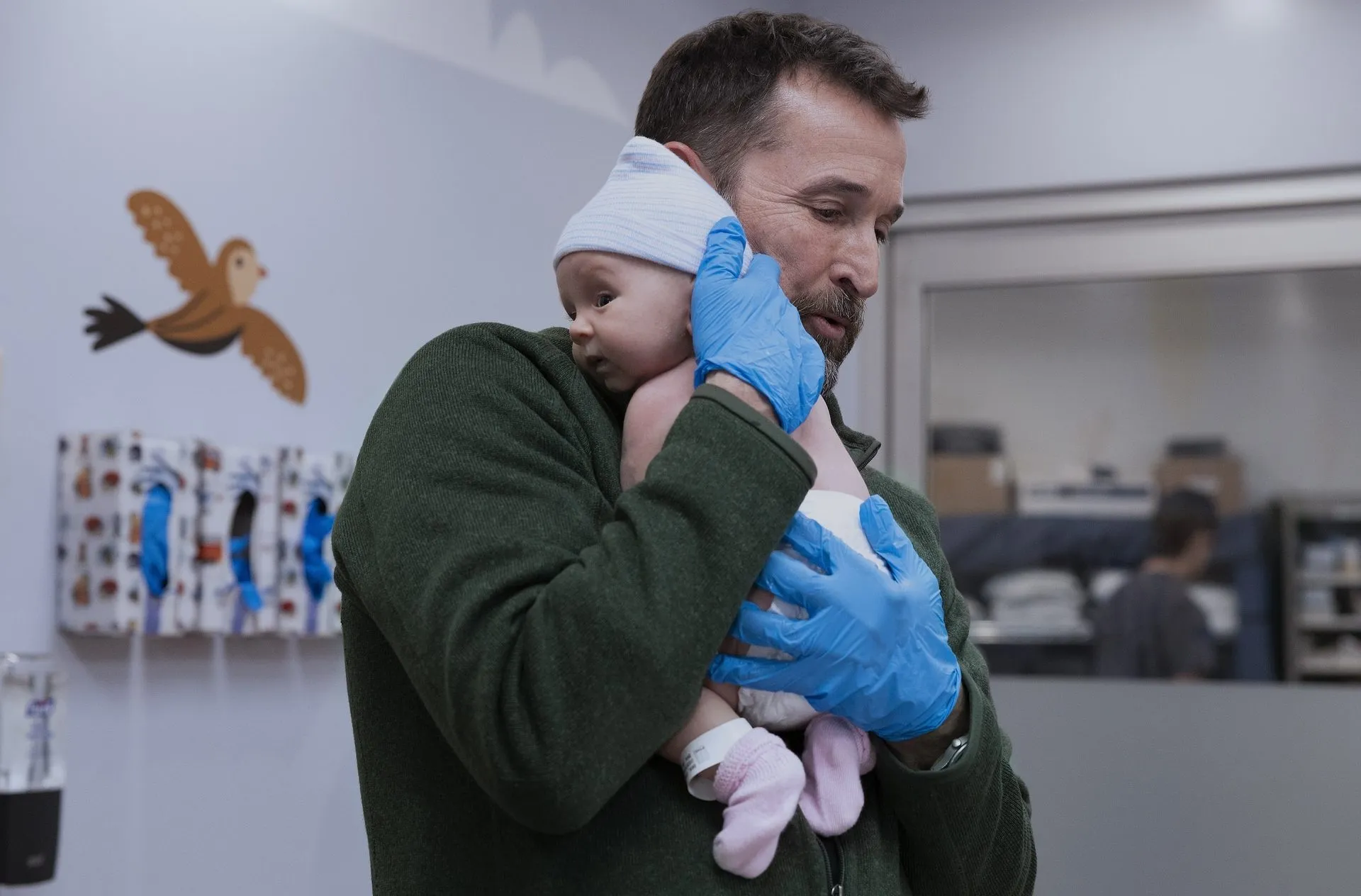
The Pitt
Season Two
A Fourth of July shift in Pittsburgh. Fifteen hours. No cuts. No mercy.
The ER That Refuses to Look Away
Season One of The Pitt arrived in January 2025 as a quiet revolution — no IP, no hype machine, just a real-time emergency department in Pittsburgh doing what television had largely forgotten how to do: trust its characters enough to let them work. It left with five Emmy Awards including Outstanding Drama Series. Season Two, which premiered on HBO Max on January 8, 2026, arrives as a conquering hero and proceeds to behave like one.
Set over a single Fourth of July weekend — ten months after the mass casualty event that defined Season 1 — the new season asks a harder question than its predecessor. Where Season 1 was a sprint toward catastrophe, Season 2 is a slow-motion pile-up. The same hospital. The same white corridors. A different kind of pressure.
Dr. Michael "Robby" Robinavitch (Noah Wyle) is preparing for a sabbatical. Dr. Frank Langdon (Patrick Ball) is back from rehabilitation, walking into his first shift. Dana Evans (Katherine LaNasa) faces a deposition. Into the chaos arrives Dr. Baran Al-Hashimi (Sepideh Moafi) — Robby's no-nonsense VA replacement — sizing up everything from minute one. Fourth of July, it turns out, is one of the most punishing days any American ER can face.
"A proudly progressive show that serves as a counterpoint to our archconservative political moment — ICE deportations, fatphobia in medicine, AI in healthcare, homelessness — addressed with the same unabashed social consciousness that made Season 1 essential."Variety · January 2026
Where Season 1 found its drama in an intensive sprint, Season 2 finds the emotional throughline in the exhaustive endurance test of medical workers operating in a thankless system. It is, as one critic put it, a slow-motion pile-up. Each new patient, each new crisis, adds to a weight that never fully lifts. By hour eleven, the audience is as exhausted as the doctors, and that is entirely the point.
The Cast Does the Heavy Lifting
Patrick Ball's Langdon is the heart of Season 2. His first day back from rehabilitation — fragile, watchful, trying — is a masterclass in performing recovery without sentimentalising it. The first season gave him a crisis. This season gives him something harder: an ordinary shift that he has to get through on willpower alone.
The ensemble keeps raising its game. Isa Briones, Sepideh Moafi, Taylor Dearden, Gerran Howell — the cast continues to outperform their screen time. Moafi's Al-Hashimi is one of the season's strongest new additions: a character designed to create friction who earns genuine respect by the finale.
The real-time format earns its keep. The structure that sounded like a gimmick in Season 1 is now the show's most essential creative tool. You feel the hours accumulating. Shawn Hatosy directing "3:00 P.M." — depicting the aftermath of a collapsed water-park slide — is one of the finest single hours of television in 2026.
The season's first four episodes are its weakest, a fact confirmed by the IMDb scores that cluster at 8.1–8.2. Necessary setup work occasionally feels like setup for its own sake as new characters compete with returning arcs for screen time.
Noah Wyle and Katherine LaNasa — both Emmy winners from Season 1 — have less to work with here. Robby's pre-sabbatical positioning keeps him at a slight remove from the action's emotional core, and Dana's deposition arc, while dramatically credible, never delivers the full confrontation the first half of the season promises.
The ICE Scene That Divided Audiences
Episode 11 — in which two ICE agents drag a zip-tied, battered woman into the ER — is the season's most discussed single moment and the sharpest political statement in the show's two-year run. Supporters called it Emmy-worthy in its emotional intensity and brutal realism. Critics accused the show of letting politics interrupt an otherwise neutral medical setting.
The counter-argument writes itself: hospitals are not neutral settings. They serve the people in the most fundamental way possible. What the government does to those people is the show's subject. The scene left audiences shaken. That is exactly what it was supposed to do. The episode scored 8.7 on IMDb — the controversy did not hurt it.
Hour by Hour — IMDb Scores
| Ep | Hour | Storyline | IMDb |
|---|
How They Stack Up
Red highlights indicate where Season 2 moves the needle forward. Season 1 holds the edge in single-episode emotional devastation — "2:00 P.M." remains one of the finest hours in recent television — but Season 2 is the more ambitious and more politically courageous season of the two.
A Second Season That Earns Its Renewal
The easiest thing a show can do after winning the Emmy for Outstanding Drama Series is make Season 2 safely. Give the audience what it liked. Repeat the structure. Hold the course. The Pitt does not do this. It takes risks — political, tonal, structural — that a lesser show would have avoided entirely.
The ICE episode, the water-park collapse, the AI in medicine debate, the ASL storyline, the sustained examination of what happens to a good doctor's body and mind when the system keeps asking more of them than any human being should give — these are not easy subjects rendered in easy ways. They are the specific texture of American healthcare in 2026, addressed directly and without apology.
The finale's 9.2 IMDb score — the highest the show has ever received — is the audience confirming what the season built toward: that the slow, difficult, often uncomfortable accumulation of fifteen episodes was worth it. The Pitt Season 2 is not as immediately gripping as Season 1. It is, in the end, more satisfying.