

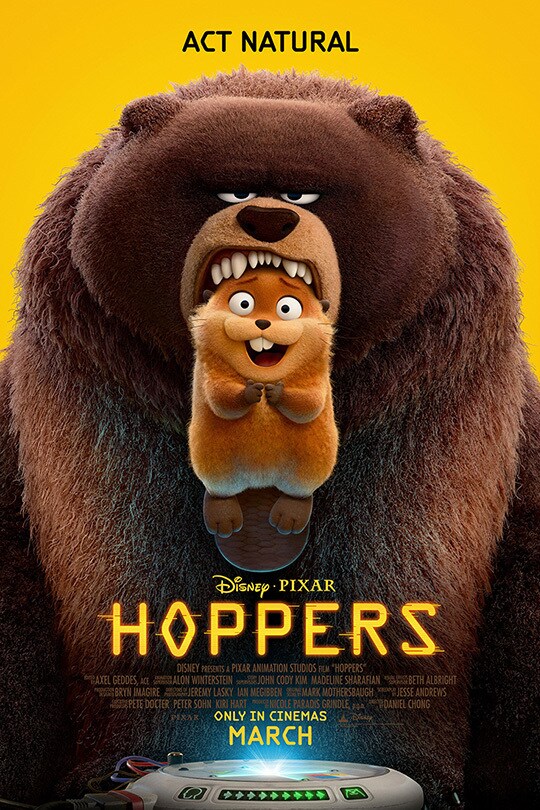
HOPPERS
What if you could become the animal you were trying to save? Pixar asks the question and somehow answers it with one of its funniest films in years.
The Premise Is Completely Insane. It Works Completely.
There is a scene in Hoppers where a shark introduces herself to a council of animals, explains that she has been fulfilling her apex predator duties, and proceeds to describe her recent activities with the cheerful earnestness of someone presenting a quarterly report. I laughed so hard I missed the next line. That is the kind of film this is. That is the kind of film Pixar remembered how to make.
Scientists have discovered how to hop human consciousness into lifelike robotic animals. A college student named Mabel, an animal lover who is quietly carrying a grief she has not found a way to name yet, seizes the opportunity, transfers her mind into a robotic beaver, and accidentally sparks an uprising in the animal kingdom. The film that follows is the funniest thing Pixar has made in years and one of the stranger things any major studio has produced in recent memory.
I sat in that cinema genuinely unsure what was going to happen next. That feeling is rarer than it should be.
The Comedy Earns the Feeling
The best thing about Hoppers is that it trusts you. It does not explain its own jokes. It does not pause for applause. It builds a running gag about how animals communicate certain emotions through emojis, deploys it across the entire runtime with increasing absurdity, and by the time it pays off in the third act you feel like you have been let into something. That is the specific pleasure of great comedy. The film earns it.
Piper Curda as Mabel is the emotional centre and she carries it with a lightness that conceals real weight. Mabel is funny. Mabel is also grieving. The film does not lean into that grief as hard as it could, and there are moments when you wish it would, but Curda ensures that the grief is always present in the performance even when the script does not directly address it. You feel something for this person. You root for her.
His scenes land differently knowing he is gone. There is a specific quality to watching someone perform with that much warmth when you know it was one of the last times they did.On Isiah Whitlock Jr. as the Bird King
Bobby Moynihan as King George is a comedic revelation. Jon Hamm and Meryl Streep do what Jon Hamm and Meryl Streep do, which is make everything better simply by being present. The late Isiah Whitlock Jr. voices the bird king with a warmth that is genuinely moving to watch in this context.
The Beaver Is Also Armour
Hoppers is about an animal lover who will do anything to protect the natural world. It is also, more quietly, about a young woman who lost someone and has not yet allowed herself to fully feel it. She throws herself into causes, into action, into adventure, because stillness is where the loss lives. The film understands this about her even when it does not say it directly.
The beaver that Mabel inhabits is not just a vehicle for comedy. It is also a kind of armour. A way of being someone else for a while. The film is wise enough to build this into the story without turning it into a therapy session and funny enough that you process the emotional logic while you are still laughing. That balance is harder to achieve than it looks. Chong and Jesse Andrews find it more often than they lose it.
The specific comic structure Hoppers uses: it builds and builds and builds and then pays off at exactly the moment you have stopped expecting it. The emoji running gag. The shark quarterly report. The animal council. Each one lands because the film has done the patient work of setting it up properly, and then trusts you to receive it without announcement.
The Second Act Wanders
The second act wanders. There is a stretch in the middle where the film circles the same comic territory it has already mapped, where the animal council sequences go on a beat or two past their natural conclusion, where you can feel the story gathering itself for a third act that it has not quite figured out how to reach yet.
The environmental message, which is genuine and genuinely felt, occasionally hedges when it should commit. The film wants to be about fighting for what you believe in. It also wants to be universally appealing. Those two things are not always compatible and Hoppers does not always know which one to prioritise when they pull in different directions.
The third act goes very dark very fast. A wildfire sequence and a shark chase that is legitimately intense reminded me that this is a PG rating doing real work. Younger children may find it more frightening than expected.
After Elio, Pixar Needed This
After Elio, Pixar needed this. They got more than they needed.
Hoppers is not Inside Out. It is not Coco. It does not reach for the profound emotional devastation that Pixar's best films achieve. What it reaches for instead is something that Pixar's best comedies have always had: the sense that you are watching something that could only have been made by people who loved making it. You can feel the joy in the animation. You can feel it in the voice performances. You can feel it in that shark scene.
Mark Mothersbaugh's score is one of his finest. SZA's end credits song Save the Day is genuinely moving. The film earns both.
Go see it. Then tell someone you love that you love them. Pixar films have always done that to you. This one does it faster than most.Youssef Reviews
Hoppers is the film that reminds you why Pixar matters. Not because it is perfect. Because it is alive. Because it makes you laugh until you miss dialogue. Because it puts a woman's grief inside a robotic beaver and somehow makes you feel both things simultaneously. The second act loses its way. The environmental politics occasionally flinch from their own conclusions. None of that undoes what the film achieves in its best moments, and its best moments are some of the best moments Pixar has produced in years.
★★★★☆